How to Pick Paint Colors for a House: What I Learned Painting Mine
f everything I have done to this house, choosing the paint colors was the part I got most wrong, most often, and for the longest time.
The floors I agonized over and then decided. The windows were expensive but the decision itself was simple. Paint was different. Paint I went back and forth on for weeks, made trip after trip to the paint store, spent real money on samples, and still ended up standing in a half-lit passage at six in the evening wondering whether the color on the wall was the same one I had approved in the morning.
It was. That is the whole problem with paint.
I should say up front that I did not work this out on my own. Lisa’s painting posts on this site got me through most of the process, and I had them open on my phone in the paint store more than once. What I did not find anywhere, including there, was the specific problem of choosing one palette for a whole house you are about to live in. So that is what this is: what I learned about how to pick paint colors for a house, inside and out, from someone who did it badly first and then figured out why.
Why The Sample Never Looks Like The Wall
Here is the thing nobody warns you about. A sample is not a small version of your finished wall. It is a completely different thing that happens to be the same color.
There are a few reasons for that, and once I understood them, the whole process got easier.
- Light changes the color. Not slightly. Completely. The same paint reads warm in a room that gets direct sun and cold in a room that only gets indirect light, and it changes again between morning, afternoon, and the moment you switch the lamps on. A color I loved in the living room looked grey and flat in the passage, and the passage color had not changed. The light had.
- The colors around it change it too. Paint does not exist on its own. It sits next to your floor, your furniture, your kitchen cupboards, your curtains. A wall color that looks perfect against a bare concrete slab can look completely different once a warm timber floor goes down in front of it. Mine had to work over three different floors, so I got a very fast education in this.
- Scale changes it. A small patch of color and a whole wall of that color are not the same experience. Whatever you are seeing in the sample, the full wall will be more of it. More warmth, more depth, more grey, more everything. This is why so many people end up with a room darker or heavier than they expected.
- And the sample itself is not always the same paint. I found that what came out of the sample pot did not always match what came out of the full can. Enough of a difference to matter when you are comparing two colors that are already close.
None of that means samples are useless. It means you have to test them properly, which I will come back to.
Start With One Decision, Not Fifty
The reason paint feels impossible is that people start at the end. They walk into the store, look at a wall of a thousand colors, and try to find the one.
Do not do that. Start with a single question.
Do you want the house lighter or darker?
That is it. That is the whole first decision, and it eliminates most of the wall in one move. Once you know you want lighter, you are choosing between maybe fifteen colors instead of a thousand. Take samples of a few of those and go home.
The second thing I would do, and this is the tip I would give anyone: ask the person behind the counter what has been trending.
I resisted this for a while because I did not want a house that looked like everybody else’s house. But there is a reason certain colors trend. They are the ones that keep working. They photograph well, they sit well with the flooring and fittings that are currently available, they suit the way houses are being built and lit right now, and they do not fight with the furniture people actually own. Your local paint store watches hundreds of houses go through that door. That is real information and it is free.
I still narrowed it down myself. But I started from their list instead of from nowhere.
The Advice That Changed Everything: One Color Through The House
This is the part I would go back and tell myself first.
We had the usual plan. Different colors in different rooms, an accent wall here, something moody in the bedroom, something fresh in the office. It is what everyone plans, because it is what you see when you look at design photos.
Then I asked two friends who do this for a living, and they both said the same thing without hesitating. They have watched this exact plan go wrong hundreds of times. People choose room-by-room color schemes for a house, it looks great while the rooms are empty, and then the furniture goes in and it does not work at all. The rug fights the accent wall. The couch that looked good against grey looks tired against green. And now you have five colors, five leftover cans, and a house that feels like five different houses.
Their advice was simple. One color through the whole house. Add accents later, once you are living in it.
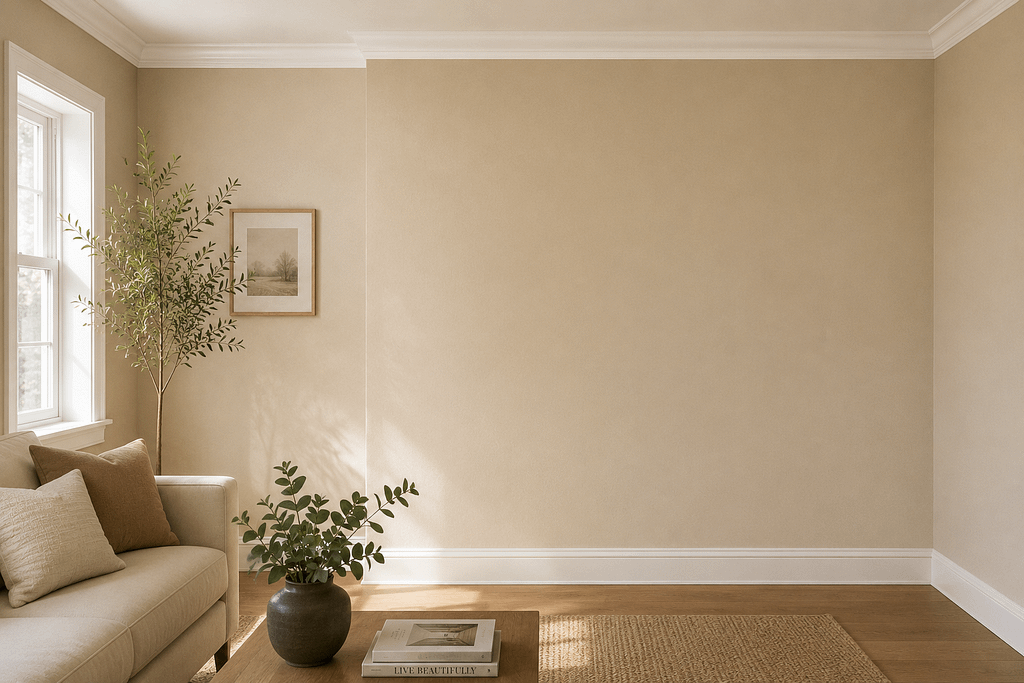
I will be honest, I was disappointed by that at first. It sounded boring. It is not boring, it is calm, and there is a difference. What it actually does is give the house flow. You walk from the passage into the living room into the bedroom and nothing jars. Every sightline works, because there is only one color in it.
And the best part is that it is completely reversible. The walls are already prepped and painted. If in eight months I decide the bedroom wants a deeper color behind the bed, that is one wall, one afternoon, one small can. Nothing wasted. The hard, dirty, expensive part is already done.
So far it has worked for us. If you take one thing from this post, take that.
The Supporting Cast: Ceilings, Trim And Baseboards
Once you have your wall color, you still have three more surfaces to decide on, and this is where a lot of color palettes for houses quietly fall apart.
We went white on all of it. Ceiling, cornice, and baseboards, all the same white.
Here is why that works, and it is worth understanding rather than just copying.
- White trim gives the wall color an edge. It frames it. Without that break, the color runs from the floor to the ceiling in one unbroken block and the room loses definition. A crisp white line at the top and bottom makes the wall color look deliberate.
- One white is simpler than three. Whites are not neutral. They have undertones, and a slightly warm white next to a slightly cool white looks like a mistake rather than a choice. Using the same white on the ceiling, the cornice and the baseboards removes that problem entirely. It also means one product, one leftover can, and one easy touch-up.
- Match the white to the wall color, not to a chart. If your wall color is warm, a soft warm white will sit better than a bright cold white. If your wall color is cool or grey, a cleaner white works. Hold the two next to each other before you commit, in the actual room.
One more thing that matters more than people expect. Use a different sheen on the trim than on the walls. Flatter finishes on the walls, because they hide imperfections and look softer. Something more durable and slightly shinier on the baseboards, door frames and cornice, because those are the surfaces that get knocked, scuffed and wiped. Same color, different finish, and the trim reads as trim rather than as more wall.
Working Around The Floors
This was the complication in my house, and it is the thing to check before you commit to a single wall color.
I have three flooring materials. Vinyl oak through the living areas and passages, wood in the bedrooms, and microcement in the office, kitchen and bathroom. Three different tones, three different textures, all under the same wall color. (I wrote about how I chose them in my flooring post if you want the full story.)
A single wall color has to survive all of that. And this is where sampling in one room only will fail you. Test the color against every floor in the house, not just the one in the room you care about most. The color that flatters a warm timber floor can go slightly flat over a cool grey one.
A neutral with a hint of warmth handled this best for us. It is the colors that lean hard in one direction that struggle to sit over more than one floor tone.
The Outside Was Harder Than The Inside
I genuinely did not expect that.
The advice we were given is that boundary walls, garden walls, anything solid that sits in front of the house, should be a shade or two darker than the house itself. It works. It makes the house read as the main event and everything else recede.
The problem is the execution. Finding a color you love for the house is hard enough. Finding an existing paint color that is precisely one or two shades darker than that specific color, in the same undertone, is much harder. They are rarely sitting next to each other on the chart.
What we ended up doing was having our local paint store mix it. Same color, dropped down in strength. So if the color is called Papyrus, they mixed Papyrus at full strength for the walls and a reduced version for the house, using the same pigment base. It looks exactly right.

The Risk, Because It Is A Real One.
A custom mix is not a stock product. If they cannot reproduce that exact formula in three years, touch-ups are not touch-ups anymore. They are repainting an entire wall to match. That is an expensive mistake sitting quietly in your future.
If you go the custom route, protect yourself. Get the formula written down, not just remembered. Keep the receipt and the tin with the code on it. Buy more than you need and store the extra properly, sealed and out of the heat. A leftover can is the cheapest insurance you will ever buy.
A Few Things Worth Knowing Before You Choose An Exterior Color
- Light exteriors show dirt. Rain splash at the base of walls, dust, algae on the shaded side, marks around door handles and gates. They look wonderful and they need washing.
- Dark exteriors show fade. Strong pigments sitting in full sun lose depth over the years, and they lose it unevenly, so the sunny wall ages faster than the shaded one. Dark colors also absorb more heat.
- Very dark or very saturated colors are harder to touch up for the same reason, and they are usually the ones that were custom mixed in the first place.
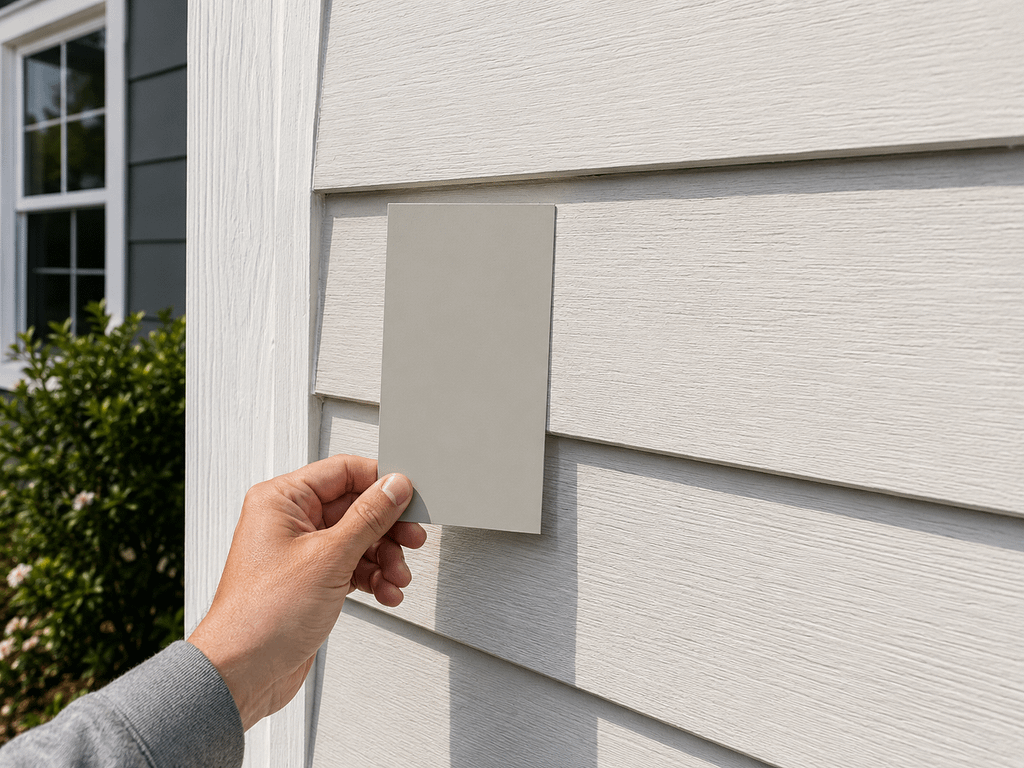
- Whatever you pick, look at it outside. Exterior color under direct sun behaves nothing like the same color under a fluorescent tube in a paint store. Take the sample outdoors and look at it on the actual wall, in the actual light, at the time of day you are usually home.
How To Actually Test A Color
After all the wasted samples, this is the method I would use from the start.
- Decide lighter or darker first. Nothing else until that is settled.
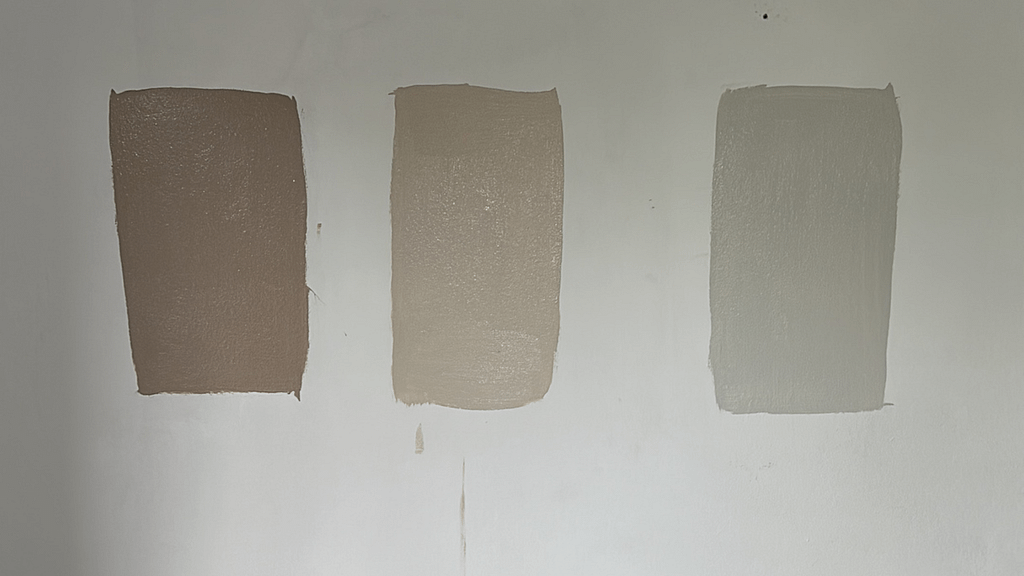
- Get three or four samples in that direction, no more. Any more and you stop being able to tell them apart.
- Paint big patches, not small ones. A postcard-sized square tells you nothing. Cover a decent area.
- Paint them in more than one room. This is the step people skip and it is the one that catches the problem.
- Look at them at three different times of day, and once with the lights on at night.
- Put your actual things in front of them. A cushion, a piece of the flooring, whatever is going in that room.
- Give it a few days before you decide. First impressions of a color are unreliable.
If you would rather not paint directly onto the wall, paint the patches onto board and move them around the house instead. Same information, and you can carry the color into the room you are worried about.
What I Would Do Differently
- I would have made the lighter-or-darker decision on day one. Weeks of wandering the paint aisle came from not having narrowed anything down before I got there.
- I would have asked the designers before I bought samples, not after. The one-color advice would have saved me most of the samples I paid for.
- I would have tested against every floor, not just the living room. I got a little lucky here rather than clever.
- I would have bought more of the custom exterior mix than I did. Right now it works. In three years, if that formula has moved on, I will wish I had another can in the garage.
A Few Questions I Get Asked
Should I paint before or after the floors go in?
We did the messy prep work and the first coat first, then the floors, then the final coat once everything was in. It worked well. The final coat covers the marks that installation always leaves.
Is one color throughout the whole house not boring?
It is calm rather than boring, and it is the only approach I know of that lets you change your mind cheaply later. Add the accent wall in year two if you still want it.
How many samples should I buy?
Fewer than you think. Three or four in the direction you have already chosen. Past that they blur together and you start second-guessing colors you had already ruled out.
Do I have to use white on the trim?
No, but it is the safest choice, and it stays safe when you change the wall color later. If you go with something other than white, keep it consistent through the whole house for the same reason the walls are.
Kaylin Bailey renovated her own home and writes about the parts of the process nobody mentions until you are standing in them. Read about the rest of the renovation in Things I Learned Buying a Fixer Upper.